Total Pageviews

One of the Top 100 Education Blogs

View All 100 Blogs

Monday, 6 October 2014

Teaching Maths the Singapore Way


September 2014 saw the launch of a new National Curriculum with lots of changes. The new maths curriculum was perhaps one of the most controversial:

'New national curriculum to introduce fractions to five-year-olds' The Guardian July 2014

'Is the proposed new national curriculum too much too soon?' The Guardian 1st April 2013

Despite the initial furore teachers all over the country are now getting on with the business of delivering the new curriculum which aims to ensure all pupils žbecome fluent in the fundamentals of mathematics so that they are:
  • efficient in using and selecting the appropriate written algorithms and mental methods, underpinned by mathematical concepts  
  • can solve problems by applying their mathematics to a variety of problems with increasing sophistication, including in unfamiliar contexts and to model real-life scenarios   
  • can reason mathematically by following a line of enquiry and develop and present a justification, argument or proof using mathematical language.
We have to ensure that we are catering for the needs of every child in our class/group. Merely repeating the same instruction ten times does not work for some children. They need to be able to understand the process rather than just rattle off facts. Only then will they have a real grasp of the number system and be able to apply that to a range of problem solving activities. 

The expectation is that the majority of pupils will move through the programmes of study at broadly the same pace. However, decisions about when to progress should always be based on the security of pupils’ understanding and their readiness to progress to the next stage. Pupils who grasp concepts rapidly should be challenged through being offered rich and sophisticated problems before any acceleration through new content. Those who are not sufficiently fluent with earlier material should consolidate their understanding, including through additional practice, before moving on.

But how can this be achieved when there are still pupils who find maths a challenge, they just don't get it! And others find it a chore? How do we raise the bar in terms of competency and engagement?

Findings from Ofsted 2011 provides some clues:
  • Practical, hands-on experiences of using, comparing and calculating with numbers and quantities … are of crucial importance in establishing the best mathematical start …
  • Understanding of place value, fluency in mental methods, and good recall of number facts … are considered by the schools to be essential precursors for learning traditional vertical algorithms (methods)
  • Subtraction is generally introduced alongside its inverse operation, addition, and division alongside its inverse, multiplication
  • High-quality teaching secures pupils 'understanding of structure and relationships in number … 
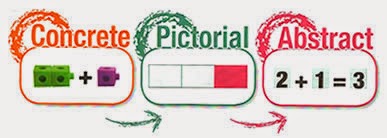
The Singapore Method may provide some answers. The Singapore method of teaching mathematics develops pupils' mathematical ability and confidence without having to resort to memorising procedures to pass tests - making mathematics more engaging and interesting. It follows and is based upon the CPA (Concrete Pictorial and Abstract model.)


Concrete - Using solid, hands on resources to help with the understanding of maths/
It is important to use practical resources to ensure children understand the process of calculations, such as making a number ten times bigger or increasing a number by 12 means we now have 12 more of something, rather than maths just being an abstract activity that ‘we just do’
 

Pictorial -  Using diagrams and images to represent numbers and symbols.  Here, children move away from physical, hands on objects and instead use pictures for demonstrations and also recording. 


ž 
Abstract - Moving onto the use of numbers and symbols in a conventional written method. 
 
 
The CPA model is nothing new to Early years and KS1 however where through the guise of continuous provision it has provided pupils with real life experiences of maths. However, I believe it can improve and enhanve the teaching and learning of maths into KS2 and beyond.
 
There is a new Maths Curriculum that we are all beginning to implement. So it is a perfect time to try the CPA approach to teaching maths, starting now! Start by using the main principal of providing the children with the concrete and pictorial before the abstract then if that's successful try the Bar Method. But  that's a whole new blog post!

Saturday, 27 September 2014

Evidence versus Mindfulness?


In the run up to her highly anticipated series of concerts at the Hammersmith Apollo at the beginning of September, Kate Bush released a statement appealing to her fans to put down their mobile phones at her gigs. Bush wrote on her website: "I have a request for all of you who are coming to the shows. We have purposefully chosen an intimate theatre setting rather than a large venue or stadium. It would mean a great deal to me if you would please refrain from taking photos or filming during the shows. "I very much want to have contact with you as an audience, not with iPhone's, i Pad's or cameras. I know it's a lot to ask but it would allow us to all share in the experience together." 

This really struck a cord with me. I have been guilty of this myself, filming and photographing events rather than engaging in them directly. I realise now that the result of this was that instead of 'living in the moment' I had merely become a spectator in my own life.  We are it seems creating and encouraging a culture of distraction where we are increasingly disconnected from the people and events around us. 

Sadly this phenomenon is not limited to the smartphone or even just to technology. We are increasingly distracted and some may say obsessed by recording everything from concerts, our holidays, days out, the list is endless. This takes the form of photographs, videos and written and typed notes. Evidence has become king!

My daughter recently gave birth to my second Grandson and I was truly blessed and honoured  to be her birthing partner. She had a very nice midwife who delivered the baby safely and soundly, she was competent and committed to her job. However.  I couldn't help but notice how much time the midwife spent typing up notes throughout the labour. She didn't have to leave the room to type up the notes as computers are installed in each delivery room. But whilst this meant she didn't have to leave the room she still wasn't actually 'living in the moment' and caring for her patient, she was distracted. At one point whilst my daughter was having a contraction the midwife was at the computer typing furiously, she then looked over her shoulder briefly to say 'Keep breathing through it!' I couldn't believe what I was witnessing. 

The midwifes job it appeared to me at that moment had changed from caring for the mother during labour to making copious notes for evidence and recording data. I am sure that is the total opposite of what this and any midwife would like to be doing. They do, I am sure, go into their profession to care for people but both they and the mothers under their care are being deprived of this due to societies constant need to record everything! 

This then got me thinking about teaching, a profession like most teachers I am passionate about. But despite my years of experience I find myself caught up in this drive to record and evidence everything! Ofsted love evidence which can be seen from numerous school inspection reports on their own website:

 'The quality of written marking is inconsistent, and too few opportunities are provided for students to respond to the advice given.'

Does marking and evidence in books improve or enhance the learning? And if it does is this then outweighed by taking the focus of teachers away from the important job, teaching!


Mindfulness is one of educations latest buzzwords:

'Mindfulness involves learning to direct our attention to experience as it unfolds, moment by moment, with open minded curiosity and acceptance. Rather than worrying about what has happened or might happen, it trains us to respond skilfully to whatever is happening right now be that good or bad'  The Mindfulness is Schools Project

Have we been forced away from living in the moment with our pupils? Experiencing learning together? Seeing what develops in them and ourselves? Do we need to be more mindful not just for the pupils but for ourselves in our role as teachers? After all the evidence is in the pupils themselves not what they have written or recorded in their books. The proof of the pudding as they say is in the eating!